Most Beautiful Bridges in Japan
Aug 3, 2026
BY Chuan En Gwee
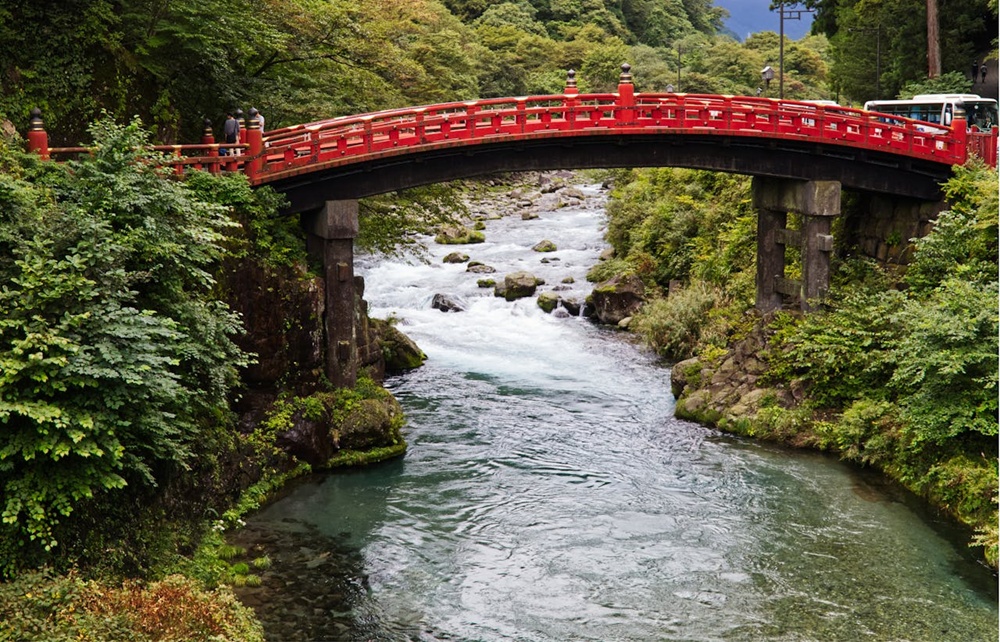
Bridges do more than carry us from one side to the other. They connect people and places, keep resources moving, support local economies, and help communities grow closer across rivers, valleys, seas, and mountains. As Thomas Harrison beautifully put it, “Bridges represent our aspirations to connect, to soar across divides.”
In Japan, that idea feels especially fitting. From elegant wooden arches and historical stone crossings to sweeping sea bridges over impossibly blue water, bridges are both practical linkways and unforgettable landmarks.
Japan even has its own Bridge Day (橋の日 / Hashi no Hi), which is celebrated on August 4, thanks to a playful word pun (8 – 4 can be read as ha-shi in Japanese). So, in honor of Bridge Day, we’re taking you across the country for an unabridged look at some of the most beautiful bridges in Japan!
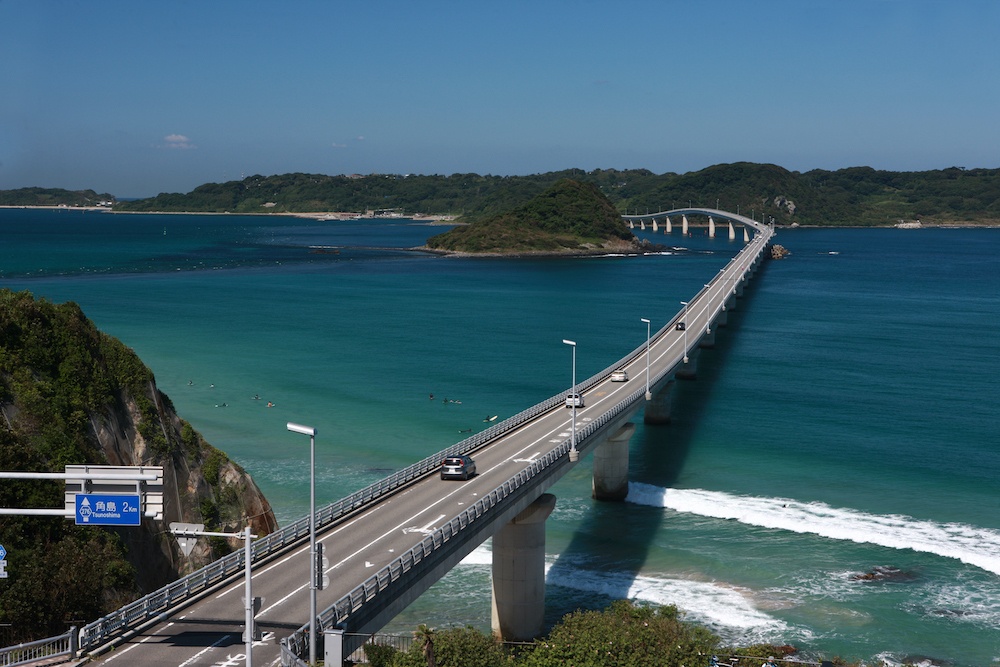
Tsunoshima Ōhashi Bridge over clear blue waters – Photo Credit: Yamaguchi Travel Guide
Tsunoshima Ōhashi Bridge (角島大橋), Yamaguchi Prefecture
Stretching across the glittering sea to connect mainland Shimonoseki City and Tsunoshima Island, Tsunoshima Ōhashi Bridge is part of Japan’s most breathtaking coastal drives. It runs for 1,780 meters (1.1 miles) over waters that shift from emerald green to deep cobalt blue depending on the light. What makes it especially striking is the way the roadway seems to float directly above the sea, creating a view that is often compared to that of a tropical island resort.
On sunny days, it is a favorite spot for road trips, cycling, photography, and scenic ocean views. The bridge is such a striking backdrop that television dramas and even car commercials are frequently filmed on and around it!
Address:
Hohokucho Oaza Kanda, Shimonoseki, Yamaguchi 759-5331
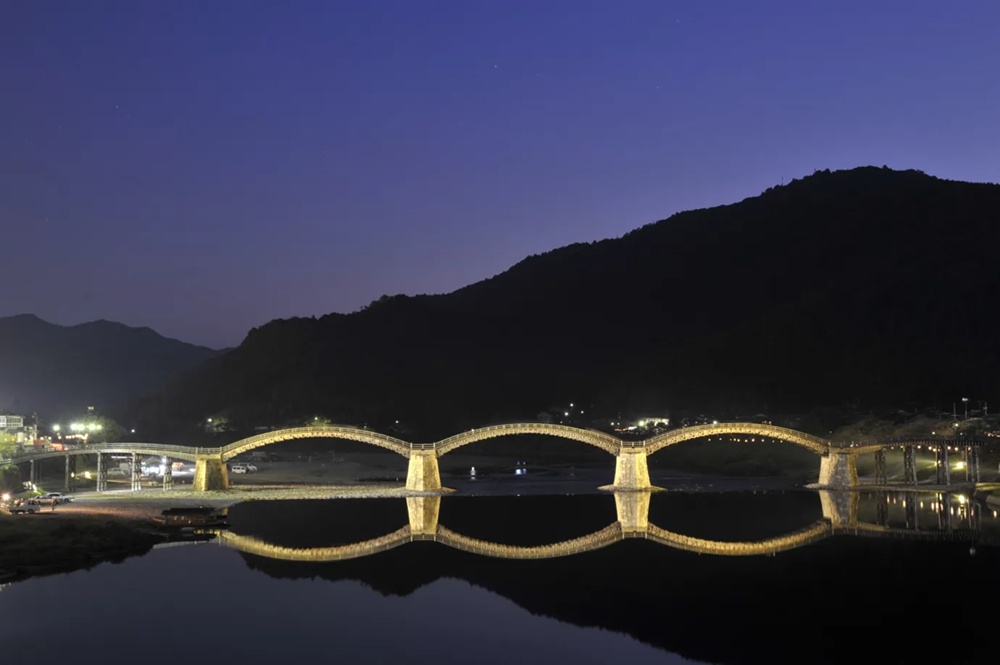
Kintaikyo Bridge illuminated at night – Photo Credit: Iwakuni Kanko
Kintaikyo Bridge (錦帯橋), Yamaguchi Prefecture
The Kintaikyo Bridge is a masterpiece of traditional Japanese bridge design, and was built in 1673 by the third lord of the Iwakuni Domain, Kikkawa Hiroyoshi (吉川 広嘉 ), in modern-day Iwakuni City. Spanning the Nishiki River, this elegant bridge is famous for its multiple arches, which rise and fall like waves against the backdrop of Iwakuni Castle and the surrounding mountains.
It is especially beautiful in spring, when cherry blossoms bloom along the riverbanks, and in fall, when the area glows with warm autumnal foliage. The bridge is also illuminated at night, providing a picturesque photo opportunity. Kintaikyo Bridge was designated a National Treasure in 1922 and is also one of Japan’s “Three Unique Bridges” (日本三奇橋, Nihon San-kikyo), meaning it is recognised and celebrated for its unique construction methods and historical significance.
Address:
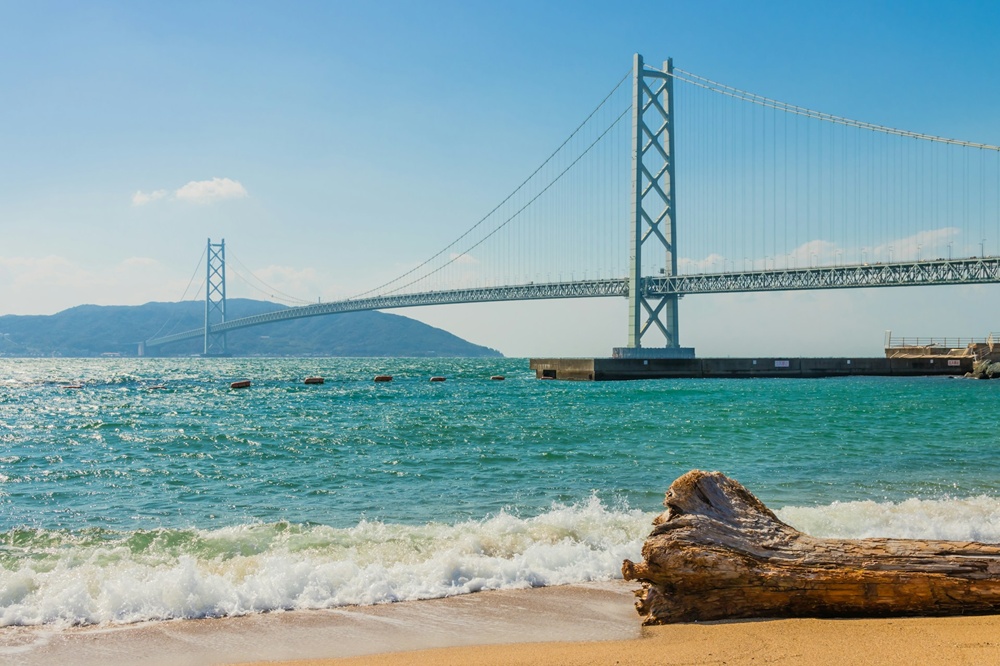
Beachside view of Akashi Kaikyo Bridge – Photo Credit: Thomas Schmitz
Akashi Kaikyo Bridge (明石海峡大橋), Hyogo Prefecture
The Akashi Kaikyo Bridge connects Kobe City in Hyogo Prefecture with Awaji Island, crossing the busy and dramatic Akashi Strait. With a total length of 3,911 meters (2.4 miles), it is definitely a monument to modern Japanese engineering. The bridge opened in 1998 after almost a decade of construction through some of Japan’s most challenging marine conditions, including strong tidal currents and deep waters. In fact, it even held the Guinness World Record for the longest suspension bridge from its construction until March 2022, when it was dethroned by Türkiye’s 1915 Çanakkale Bridge.
Its beauty lies not only in its scale but also in its graceful silhouette, which encompasses two soaring towers, long sweeping cables, and the vast Seto Inland Sea below. By day, the bridge feels majestic against the blue waters, and by night, its illumination gives it a pearl-like elegance, which is why it is affectionately nicknamed the “Pearl Bridge” by locals.
Address:
4 Higashimaikocho, Tarumi-ku, Kobe, Hyogo 655-0047
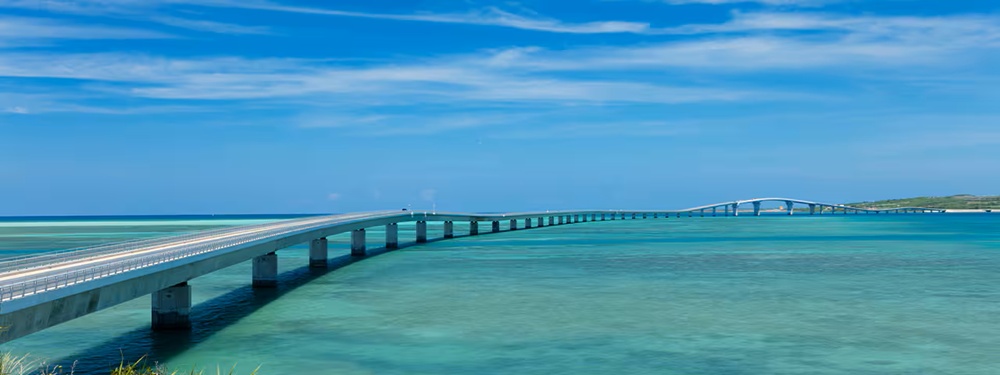
Panoramic oceanic view of Irabu Ōhashi Bridge – Photo Credit: ANA
Irabu Ōhashi Bridge (伊良部大橋), Okinawa Prefecture
Opened in 2015, Irabu Ōhashi Bridge may be one of the younger bridges on this list, but it has quickly become one of Miyakojima’s signature scenic spots for road trips and photography. Located in Miyakojima City, Okinawa, the bridge links Miyako Island with Irabu Island and is one of the most spectacular sea bridges in Japan, creating both an important practical route for locals and an unforgettable drive for travelers.
With “Ōhashi” (literally “Great/Big Bridge”) in its name, it is no surprise that, at 3,540 meters (2.2 miles), Irabu Ōhashi Bridge is the longest toll-free bridge in Japan. The crossing experience is just as impressive as its scale, as the surreal drive takes you through the gently rising road over the brilliant “Miyako blue” sea and opens up views toward the islands.
Address:
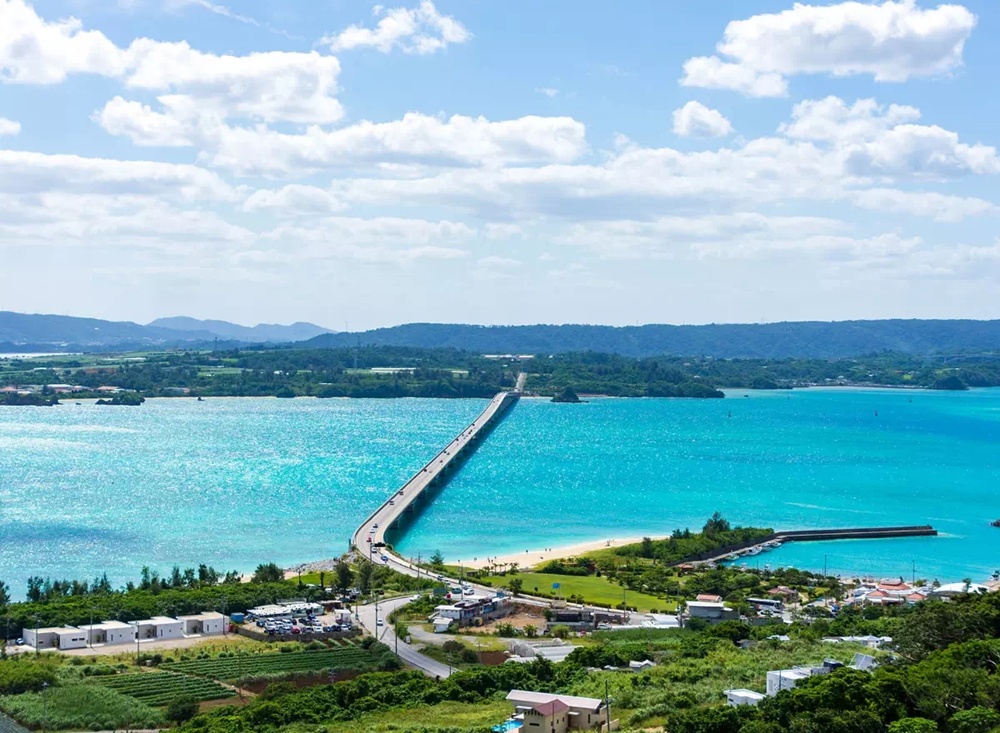
Kouri Ōhashi Bridge seen from Kouri Ocean Tower – Photo Credit: Visit Okinawa Japan
Kouri Ōhashi Bridge (古宇利大橋), Okinawa Prefecture
Next on the list is another Okinawan bridge, the Kouri Ōhashi Bridge, which connects Yagaji Island in Nago City with Kouri Island in Nakijin Village, in northern Okinawa. At 1,960 meters (1.2 miles) long, it is one of Okinawa’s most loved scenic bridges, famous for the dazzling coral sea that spreads out on both sides of the road.
Driving towards Kouri Island provides a particularly stunning view: the bridge seems to glide straight across layers of turquoise and emerald water, giving visitors the feeling of driving on the ocean itself. After crossing, travelers can stop at Kouri Beach or nearby local markets, making it an easy and rewarding addition to an Okinawa road trip.
Address:
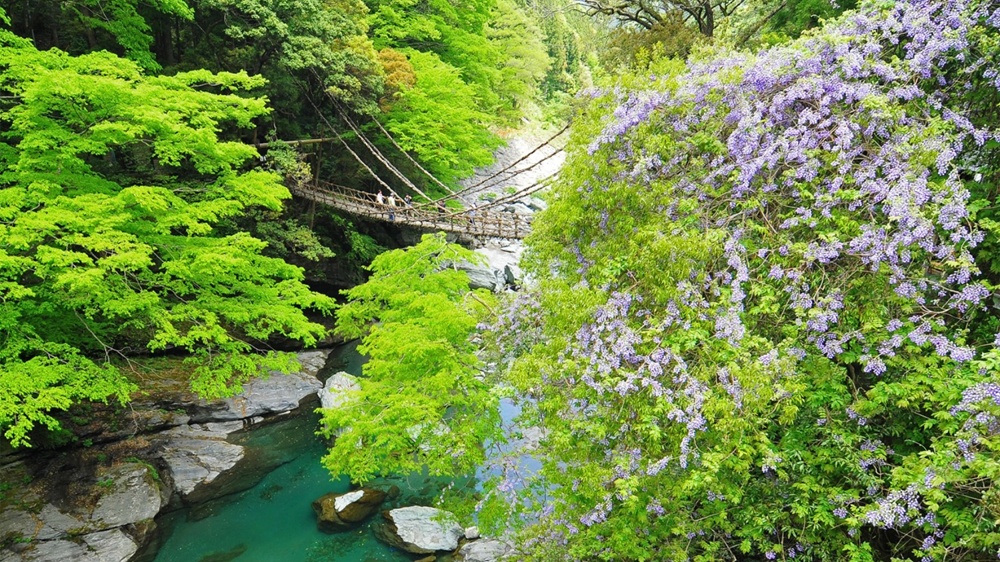
Iya-no-Kazurabashi Bridge in Spring – Photo Credit: Miyoshi City Tourism Association
Iya-no-Kazurabashi Bridge (祖谷のかずら橋), Tokushima Prefecture
Deep in the mountains of Miyoshi City in Tokushima, Iya-no-Kazurabashi Bridge, translated as “Iya Valley Vine Bridge,” offers a completely different kind of beauty from Japan’s ocean bridges. In leagues with the second bridge on our list, it is one of Japan’s “Three Unique Bridges” (日本三奇橋, Nihon San-kikyo). This rustic suspension bridge is made from shirakuchi-kazura vines and hangs above the waters of the Iya Valley, one of Shikoku’s most atmospheric mountain regions.
Its origins are shrouded in mystery: some say Iya-no-Kazurabashi Bridge was built by fleeing Heike Clan (平家) warriors after their defeat in the 12th-century Genpei War, who used easily severed vines so the bridge could be cut down if pursuers approached. Other accounts say it was built by Kobo Daishi, a great Buddhist monk, to help local villagers cross the steep valley safely. Whatever its true origin, there is no doubt that the bridge offers visitors a glimpse into the past, through the well-preserved customs of feudal Japan found throughout the Iya Valley.
Address:
162-2 Nishiiyayamamura Zentoku, Miyoshi, Tokushima 778-0102
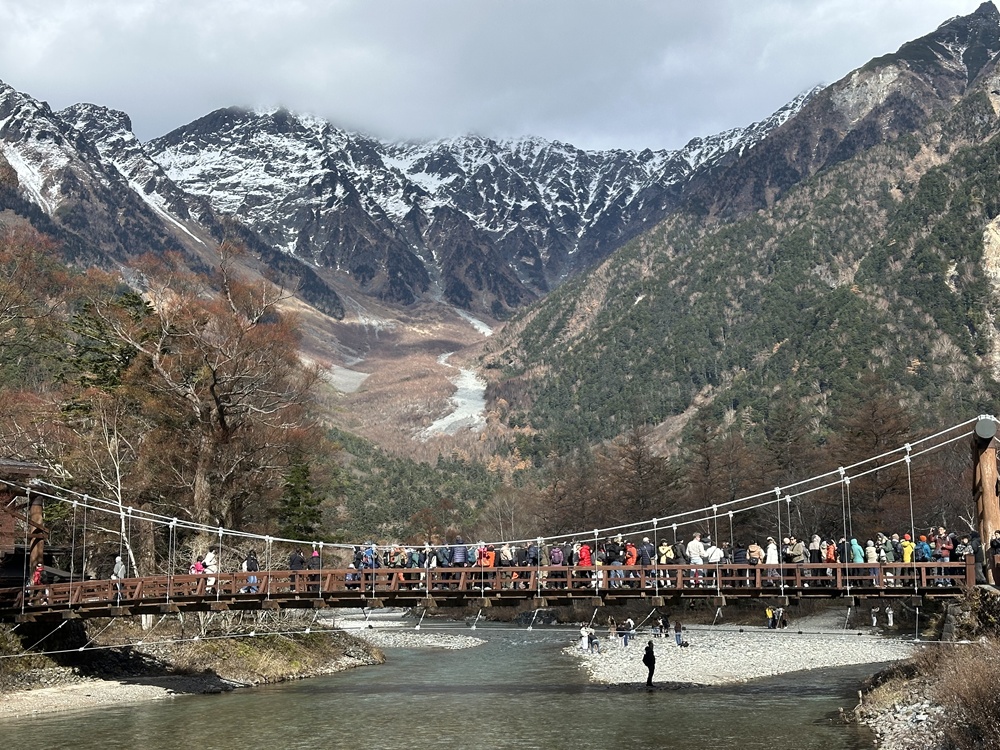
Densely packed Kappabashi Bridge in Autumn – Photo Credit: Chuan En Gwee
Kappabashi Bridge (河童橋), Kamikochi, Nagano Prefecture
In the heart of Kamikochi, the Kappabashi Bridge is beloved not for grand engineering, but for the extraordinary landscape it frames. The wooden suspension bridge crosses the crystal clear Azusa River, with a magnificent mountain range in the background. It has become the symbol of Kamikochi and a natural gathering point for hikers, photographers, and travelers entering the Japanese Alps.
The simply designed bridge was immortalized forever by Ryūnosuke Akutagawa’s 1927 novella “Kappa,” where the protagonist travels to Kamikochi and meets the kappa, a cucumber-loving mythical creature in Japanese folklore.
Address:
Kamikochi Azumi, Matsumoto, Nagano 390-1516
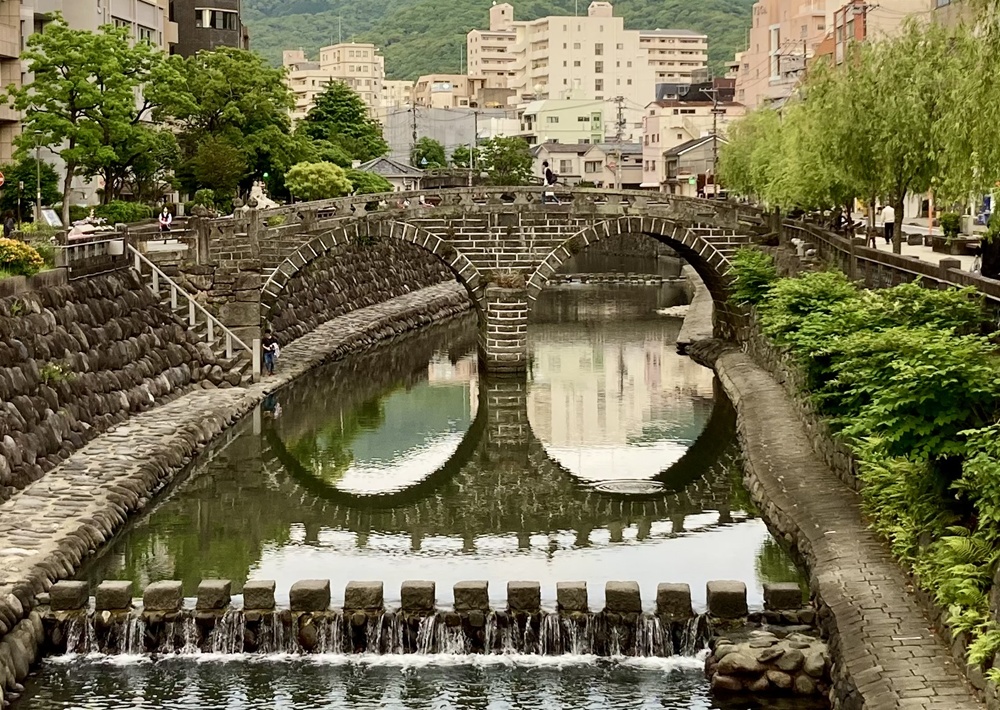
Meganebashi (Spectacles) Bridge’s reflection – Photo Credit: Chuan En Gwee
Meganebashi Bridge (眼鏡橋), Nagasaki Prefecture
Meganebashi, or “Spectacles Bridge,” is one of the most charming historic bridges in Japan, located over the Nakashima River in Nagasaki City. Built in 1634 by the monk Mokuso Nyojo of Nagasaki’s Kofukuji, this stone arch bridge gets its name from the reflection it creates on the water: when the river is calm, the two arches and their mirrored image form the shape of a pair of eyeglasses.
With its quiet, refined beauty and timeless stonework set against Nagasaki’s urban scenery, Meganebashi more than earns its place among Japan’s historic “Three Famous Bridges” (日本三名橋, Nihon Sanmeikyo). The area is also popular for riverside strolls, lantern festival views, and the search for lucky heart-shaped stones embedded in the river’s stone walls.
Address:
2 Uonomachi, Nagasaki, 850-0874
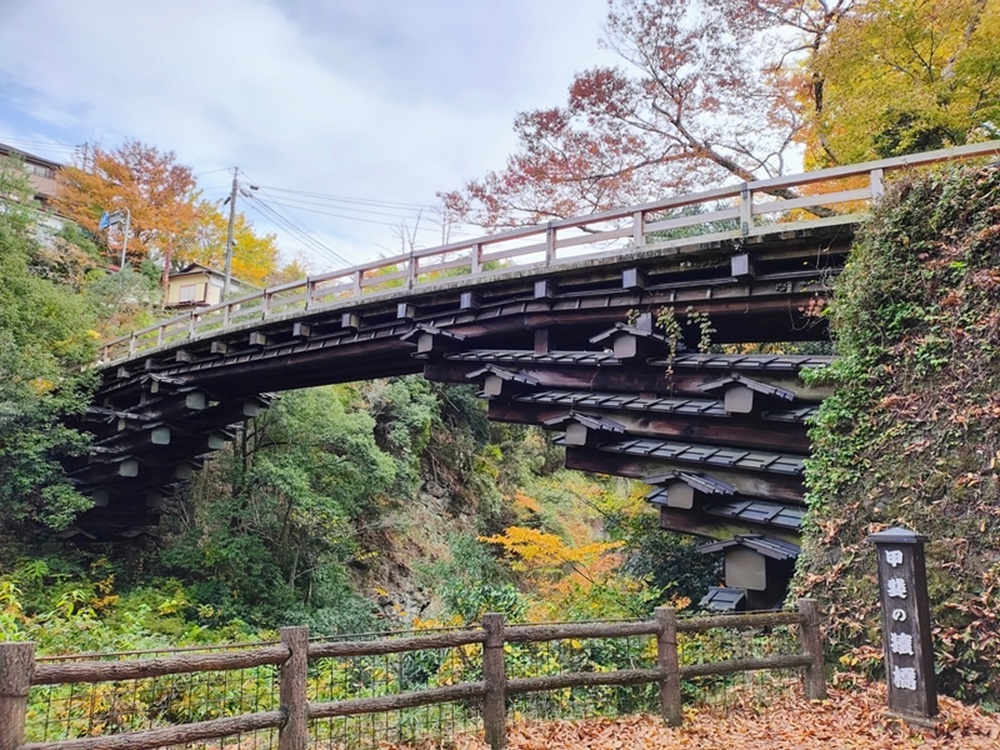
Saruhashi Bridge with hanegi beams – Photo Credit: Otsuki City Tourism
Saruhashi Bridge (猿橋), Yamanashi Prefecture
Located in Otsuki City, Yamanashi, Saruhashi Bridge is one of Japan’s most unusual and atmospheric bridges. Though modest in size, being only about 31 meters (102 feet) long, it is famous for its rare structure: rather than standing on bridge piers, it is supported by layers of projecting wooden beams called hanegi (羽根木), which extend out from both sides of the steep gorge.
This design was used because the valley is too deep and narrow, preventing the use of ordinary bridge supports. The result is a striking bridge that seems to cling to the cliffs, especially beautiful in autumn when the surrounding foliage turns red and gold. Its uniqueness played a part in granting it the status of one of Japan’s “Three Unique Bridges” (日本三奇橋, Nihon San-kikyo)
Address:
Saruhashimachi, Otsuki, Yamanashi 409-0614
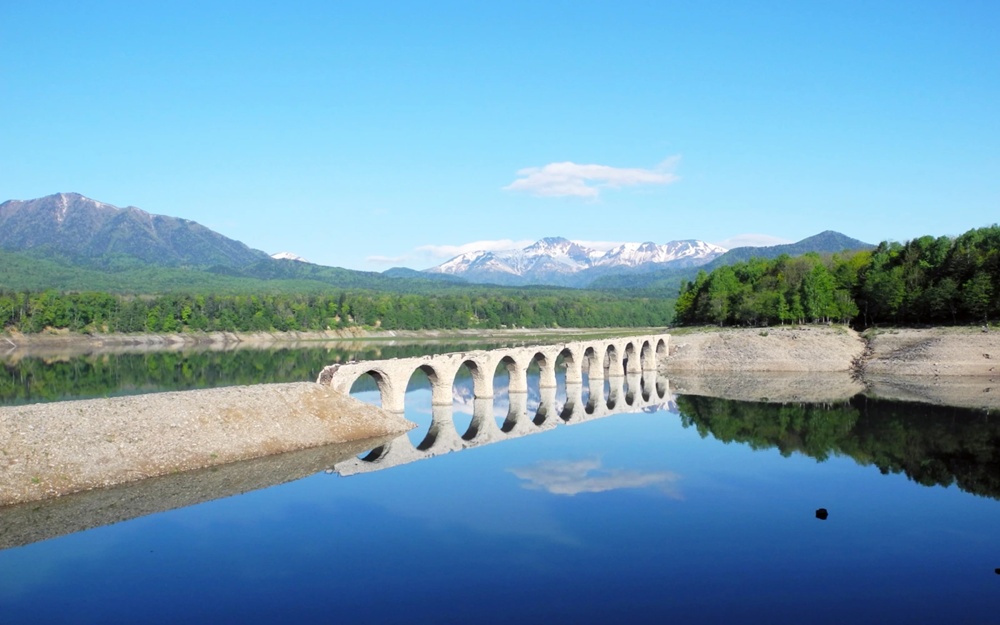
Taushubetsu River Bridge with its looping arches – Photo Credit: Kamishihoro Town Municipal
Taushubetsu River Bridge, Hokkaido Prefecture
In Kamishihoro, Hokkaido, the Taushubetsu River Bridge is often called the “phantom bridge” because it appears and disappears with the changing water level of Lake Nukabira. Once part of the former Japanese National Railways Shihoro Line, this concrete arch bridge now stands as a hauntingly beautiful ruin, its series of arches evoking shades of an ancient Roman aqueduct amid the mountains, forest, and water.
Taushubetsu River Bridge usually begins to appear around January, when the lake’s water level is low and the lake surface freezes. It is generally most visible from winter to early spring, especially before the water rises. From around June, it gradually sinks as the water rises, and between August and October, it may disappear beneath the lake entirely. The bridge’s cyclical transformation helps to make every trip special, as no two visits offer quite the same view.
Address:
Nukabiragensenkyo, Kamishihoro, Kato District, Hokkaido 080-1403
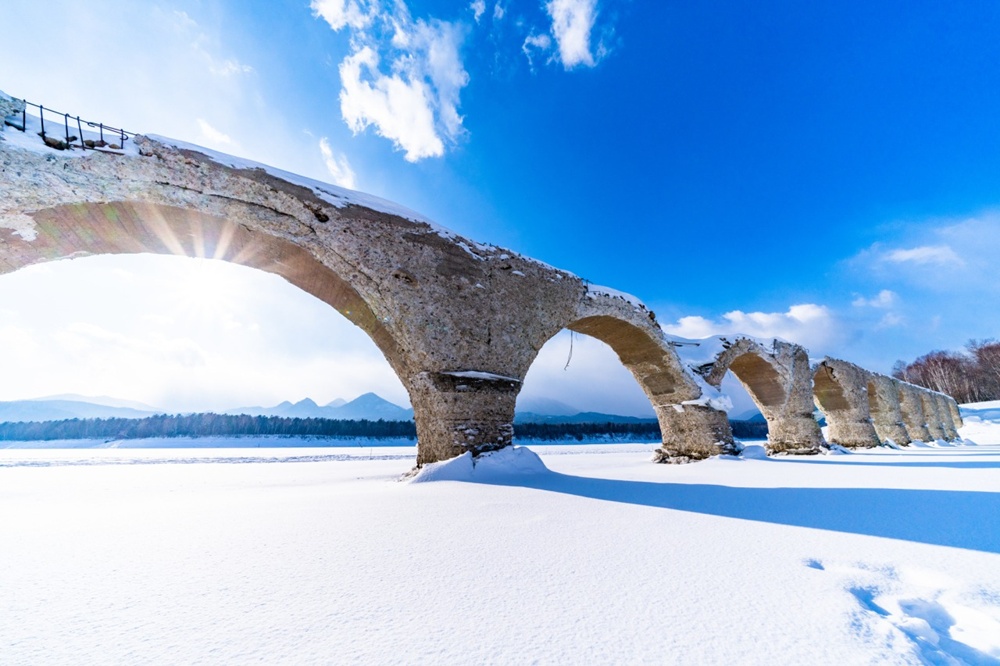
Taushubetsu River Bridge’s snowy winter view – Photo Credit: Hokkaido Tourism Organization
Bridging the Gap Between You and Japan
And that’s our list of the most beautiful bridges in Japan! From vine bridges hidden deep in mountain valleys to sweeping ocean crossings over Okinawa’s turquoise seas, Japan’s bridges show just how beautifully function and scenery can come together. Some are centuries-old works of craftsmanship, others are modern engineering marvels, but each one tells a story of connection: between islands, communities, landscapes, and eras. Whether you are crossing them by car, on foot, or simply admiring them from afar, these bridges remind us that the journey between two places can be just as memorable as the destination itself.
Featured Photo Credit: Abdus Samad Mahkri
And if you’re looking for an insider’s look at Japanese food, culture, and sights, our Culinary Tours and Tailored Travel Planning Services are here to help you “bridge” the gap between you and Japan, one memorable experience at a time!
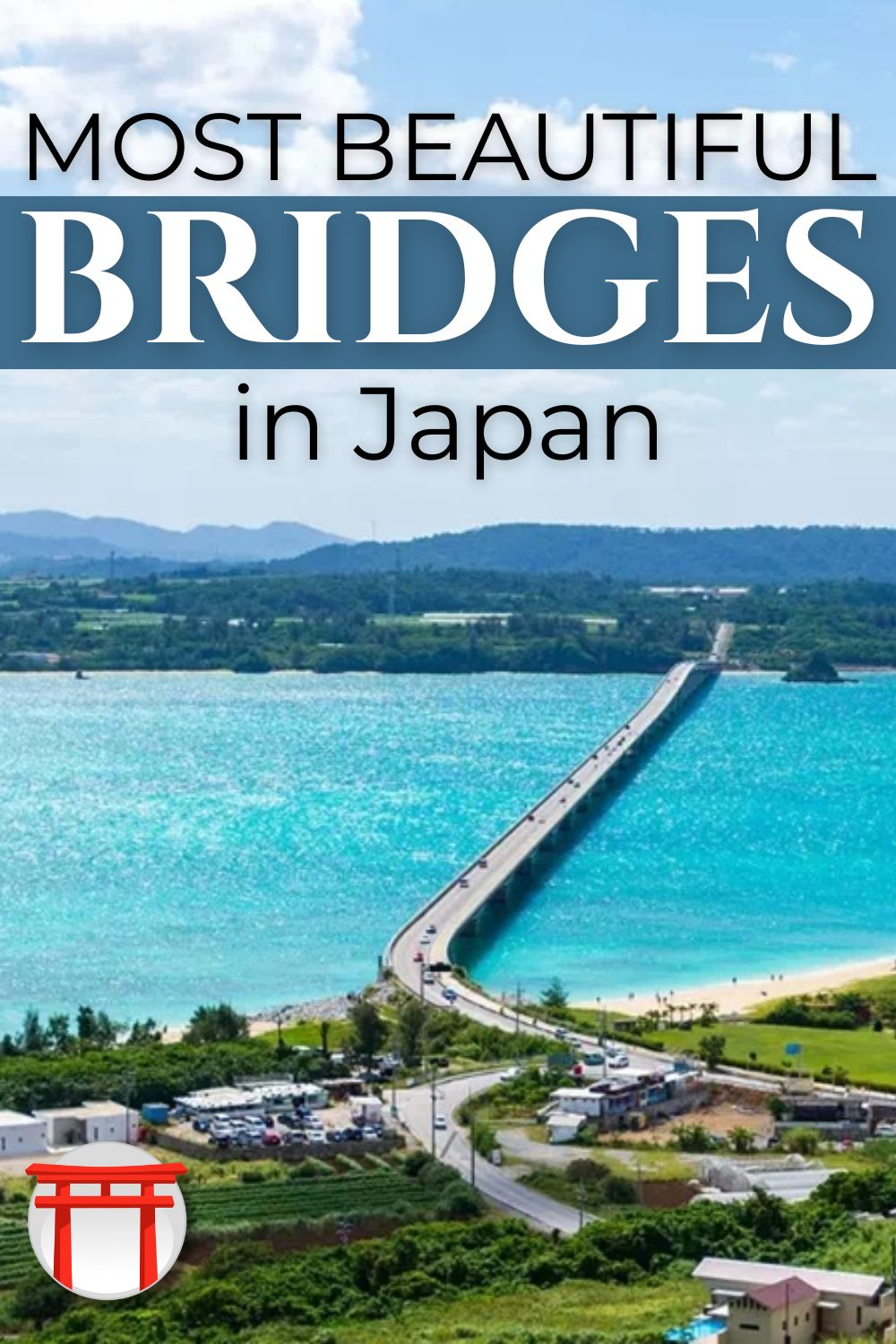
PIN THIS FOR LATER
Book your pocket wifi now to stay connected through your entire Japan Journey!

Be sure to get the JR Pass to make navigating Japan during your trip that much easier!
YOU MIGHT ALSO LIKE